A screwcap or cork is a closure choice before it is a prestige signal
The sound of opening a bottle can carry strong expectations, but closure type alone does not rank red-wine quality. Read the actual wine and practical service requirements first. A useful choice considers opening, resealing and producer guidance without turning one closure into proof of sophistication.
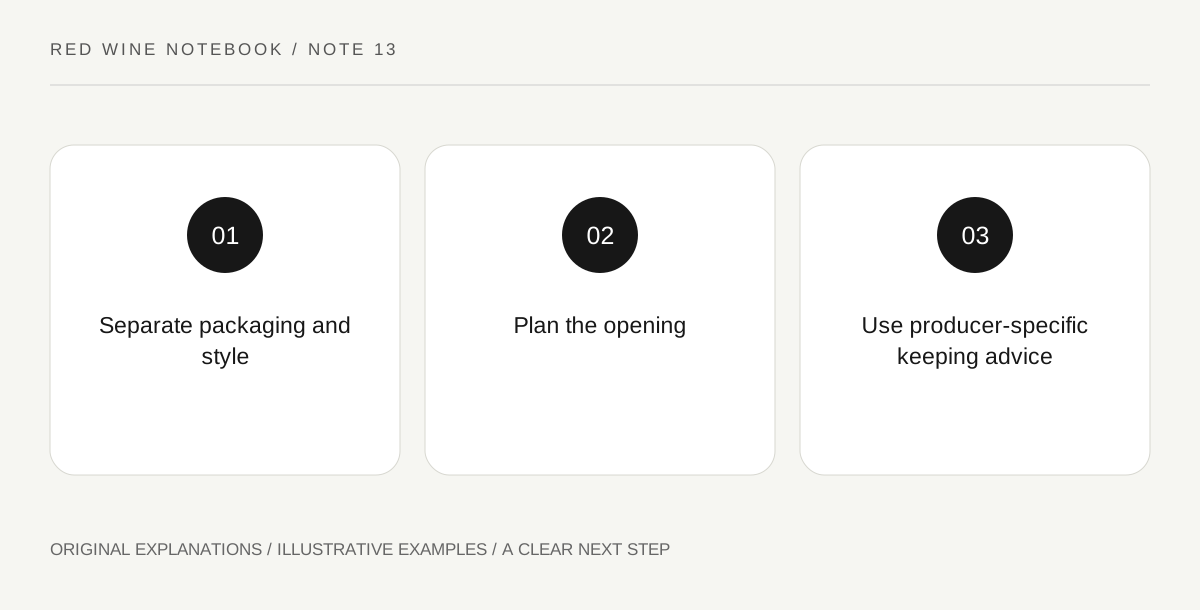
Original explanatory diagram. Read the full method and limitations below.
Separate closure from the wine description
WSET explicitly notes that closure type does not reflect overall wine quality. Keep the closure in a packaging field and the wine's style in another. A screwcap does not identify one grape or guarantee immediate simplicity, and cork does not guarantee complexity. Read the producer and current bottle details. If a shop organizes prestige through packaging, ask for the actual style information that connects with what you enjoy instead of accepting the closure as a complete evaluation.
Consider the opening task
Check what equipment and comfortable handling the closure requires. If giving a bottle to an adult who wants it, practical access can matter more than ceremony. A cork-based opening should follow suitable tool instructions, while a pressurized sparkling closure needs its own specific handling. Do not apply one opening method because a bottle looks familiar. If the closure is damaged or the process becomes difficult, seek assistance rather than forcing fragile material or improvising an unsafe tool.
Read keeping advice independently
A convenient resealable cap can simplify an opened-bottle routine, but it does not make the wine unchanged indefinitely. A cork does not automatically establish that the wine must be saved for years. Use producer advice for storage and further development, with the actual style and intended duration in view. Packaging convenience and wine evolution are related considerations, not interchangeable facts. Keep the opening date and product identity if the bottle is stored for another occasion.
Write the preference honestly
You may enjoy a traditional opening ritual or prefer the simplicity of a screwcap. Either preference can be stated without inventing a quality claim. A purchase note might say easy to open for this setting, while the style note describes the actual red. If comparing two products, do not attribute every flavor difference to their closures when producer, vintage, grapes and storage also differ. A controlled scientific conclusion requires more evidence than two unrelated bottles at dinner.
Illustrative worked example
Illustrative scenario: a buyer rejects a wine they might otherwise like because it has a screwcap. A retailer supplies the actual producer and style information. The buyer recognizes that the closure addresses a practical opening need and decides on the wine's relevant characteristics instead. Whether they purchase it or choose something else, the decision no longer rests on a packaging-based quality assumption.
Questions that come up
Can screwcap wines ever be intended to develop in bottle?
Do not impose a universal ban from the closure alone. Read the producer's actual guidance for the wine and intended storage.
Does a cork prove the wine is expensive or better?
It does not supply a complete quality judgment. Evaluate the actual wine information and your needs rather than using one packaging detail as a ranking system.
References and scope
These sources support the factual background. Examples and exercises are original illustrative teaching material. References do not imply endorsement.
- WSET: Finding a Wine You Like — Closure type alone does not rank wine quality; preferences, packaging and occasion inform choice.
- WSET: Serving Temperatures and Storage — Style-specific serving temperatures and cool stable storage conditions; not a guarantee for any bottle.