Vintage, LBV and colheita: keep three Port label ideas distinct
A year on a Port label can sit beside words that change what it means for the wine's category and maturation. Keep Vintage, Late Bottled Vintage and colheita separate before considering service or storage. The exercise is label interpretation, not a recommendation to buy older or more expensive bottles.
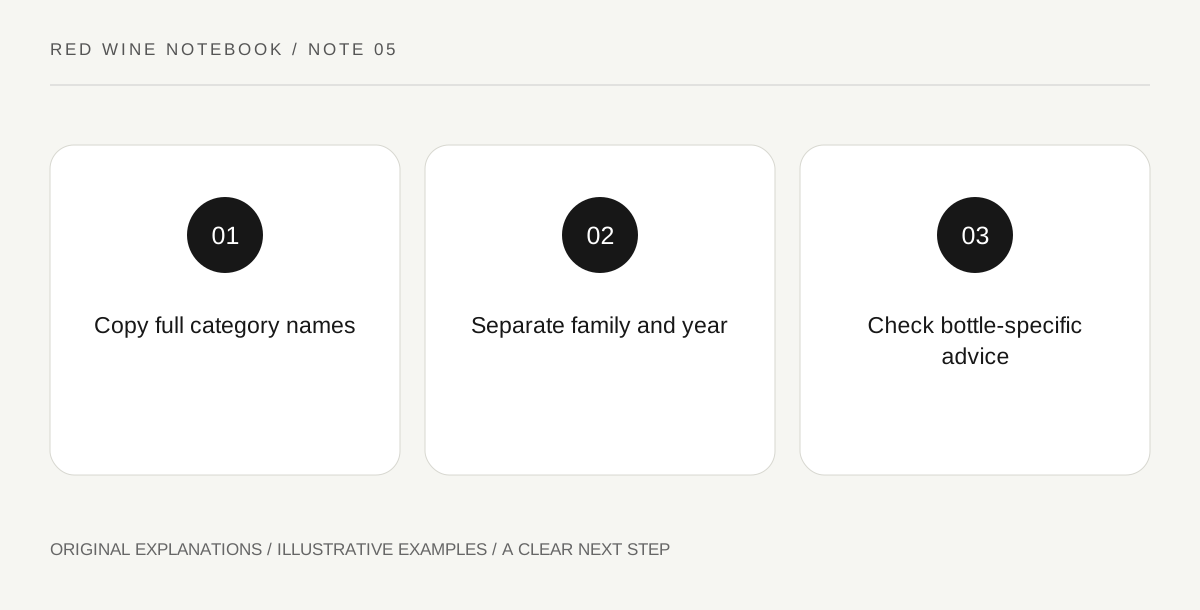
Original explanatory diagram. Read the full method and limitations below.
Copy the complete category phrase
Do not shorten Late Bottled Vintage to Vintage in your notes. IVDP describes LBV as a single-year ruby-style Port bottled after a period in wood, while Vintage follows its own category. The shared word does not make the categories interchangeable. Copy the producer, complete phrase and year where provided. A small omission in a notebook can later produce a large misunderstanding when asking a retailer for the same wine or reading a service recommendation.
Place colheita with its maturation context
IVDP describes colheita as a single-vintage tawny matured in cask. That puts a year statement into a different context from a Vintage Port category. Draw separate boxes for family, category and stated year. The purpose is to organize what the label establishes, not to infer an exact flavor or ready-to-drink date from arithmetic. If a producer supplies bottling information or specific service guidance, retain it as additional detail rather than overwriting the category.
Ask before assuming bottle development
IVDP notes that many LBV wines are ready when purchased, while some can continue to develop in bottle and the label should be checked. That is a useful reason to read the actual bottle instead of applying one automatic storage plan. Ask about filtration, sediment and current producer advice where relevant. Do not treat a prestigious category name as permission to keep a bottle in unsuitable conditions or to postpone using it indefinitely in the hope of guaranteed improvement.
Use the distinction in a practical request
A clear request might identify a specific LBV year and producer, then ask what current opening and sediment guidance applies. It should not ask for any wine with the same year and assume an equivalent product. If selecting a gift, provide the recipient with the correct category and producer information rather than a vague story about old Port. Accurate words are more useful than a dramatic claim that the bottle must be saved for a distant special occasion.
Illustrative worked example
Illustrative scenario: a shopper writes Vintage 2018 after seeing an LBV 2018 label. Before purchasing, they compare the complete label and correct the note. A separate colheita with a year is placed in the tawny-family box. The shopper now asks about the exact bottle's service and storage instead of applying one year-based rule to all three categories.
Questions that come up
Does the same year make two Port categories equivalent?
No. The year sits within a category and maturation context. Retain the complete words rather than comparing dates alone.
Should every LBV be stored for years after purchase?
IVDP says many are ready when bought and some can develop further. Read the exact bottle and producer advice instead of imposing a universal waiting period.
References and scope
These sources support the factual background. Examples and exercises are original illustrative teaching material. References do not imply endorsement.
- IVDP: Special Port Categories — Vintage, LBV, colheita and age-indicated tawny labels identify different categories.