Decanting for sediment starts with a visible separation task
Sediment gives decanting a concrete purpose that is different from a vague promise to improve every red wine. Identify whether a deposit is present and use an appropriate service method if needed. The task is careful separation, with the producer's guidance and comfortable handling taking priority over ceremony.
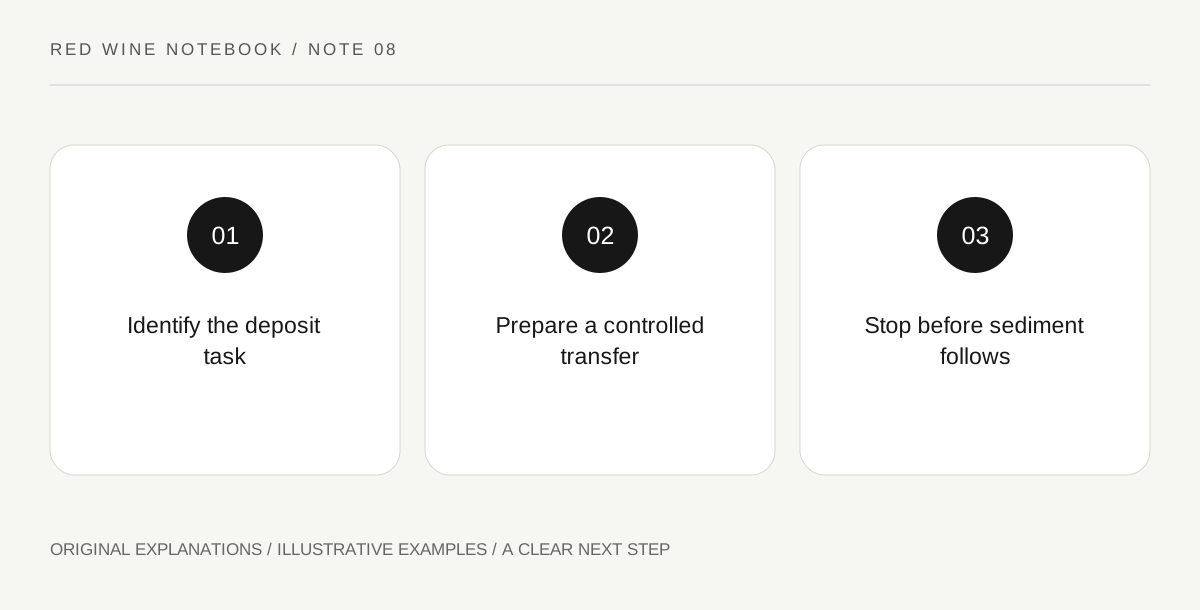
Original explanatory diagram. Read the full method and limitations below.
Confirm the reason for the transfer
WSET notes that some bottle-aged reds and lightly filtered wines can develop deposits. That does not mean every red needs decanting. Look for the producer's advice and a visible reason before adding equipment. A clear everyday bottle may not present the same task as a mature wine with a deposit. Do not shake a bottle to investigate sediment or assume that a decanter is required simply because a restaurant photograph includes one.
Arrange a calm working space
Choose a stable surface, appropriate clean glassware and enough light to see what is happening. Keep the bottle movements deliberate so a settled deposit is not needlessly disturbed. If opening or pouring the actual bottle is difficult, seek suitable help rather than forcing a fragile closure or managing a heavy vessel one-handed. The setup should make an ordinary controlled action easier. Decorative accessories are secondary to a clear view and a manageable transfer.
Stop before the unwanted material follows
WSET's sediment-separation guidance emphasizes gentle handling and stopping when the deposit approaches the neck. Follow the producer's relevant instructions and use your observation instead of aiming to transfer every last drop. Leaving a small amount behind can be part of the task. Do not add unapproved kitchen filters or improvised chemicals because the bottle contains a deposit. The goal is a clean separation, not reconstructing the wine or proving that none can be left unused.
Keep sediment separate from fault diagnosis
A deposit and an unusual smell are different observations. Do not use the presence or absence of sediment to declare that a wine is safe, faulty, prestigious or low quality. If the product's condition is concerning, ask the seller or producer rather than relying on a decorative service ritual. Record the bottle identity and the reason for decanting. An accurate note can say separated visible deposit without claiming the process made the wine objectively better.
Illustrative worked example
Illustrative scenario: a host sees a deposit in a bottle whose producer recommends careful decanting. They set up a stable surface and clear view, make the supported transfer gently and stop before the deposit follows. A little wine remains in the bottle. The note records the separation task, rather than claiming that a large decanter or a fixed waiting time improved every flavor.
Questions that come up
Does every red wine require this?
WSET explains that many everyday wines do not produce a significant deposit. Read the actual bottle and use a purpose-based decision rather than a universal rule.
Should I empty every drop into the decanter?
If separating sediment, the stopping point matters more than complete transfer. Follow suitable guidance and avoid carrying the deposit into the serving just to empty the bottle.
References and scope
These sources support the factual background. Examples and exercises are original illustrative teaching material. References do not imply endorsement.
- WSET: Serving and Decanting FAQ — Serving and decanting considerations, including sediment separation and the limits of universal decanting rules.