Let it breathe is a question about this bottle, not a universal countdown
A fixed instruction to decant every red wine for an hour sounds convenient but ignores why the transfer is being made. Separate aeration from sediment removal and consult the actual bottle's guidance. A useful observation can remain modest without promising that more air always produces a better drink.
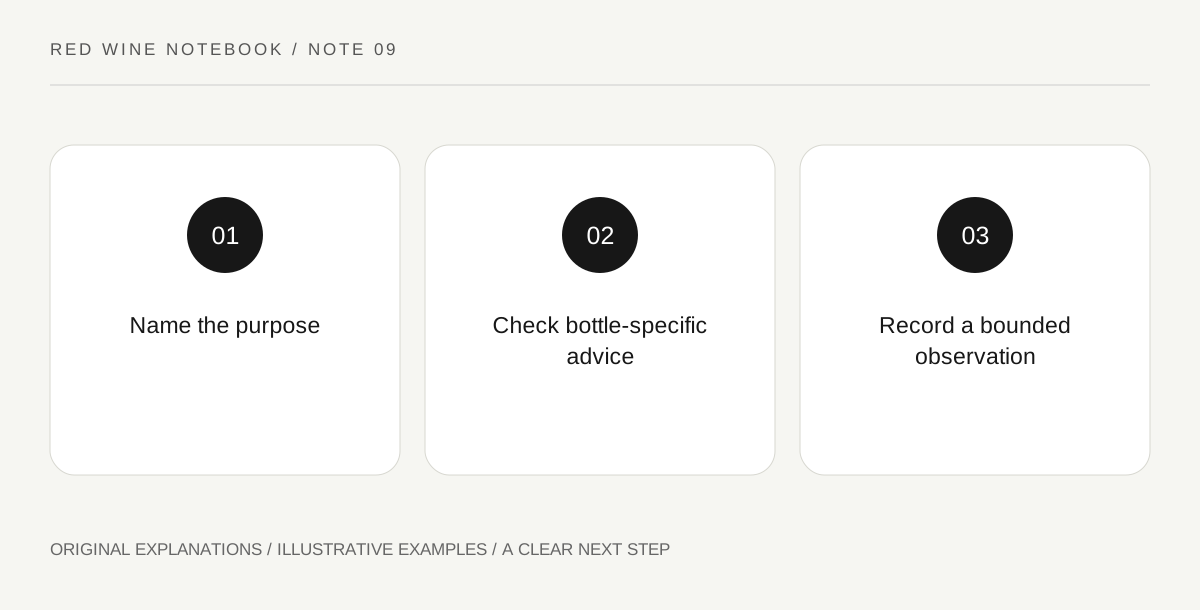
Original explanatory diagram. Read the full method and limitations below.
State the proposed purpose
Ask whether the suggested decanting is intended to separate a deposit or change exposure to air. Those are different tasks. WSET's serving FAQ describes aeration as a debated reason for decanting rather than a universally necessary improvement. Write the purpose before arranging a waiting period. If the only explanation is all expensive reds need it, seek a more specific answer from the producer or an informed seller instead of treating price as a technical instruction.
Read the actual wine guidance
A producer may offer service advice for its wine and vintage. Keep that detail attached to the bottle rather than extending it to every wine made from the same grape. Age, condition and style can matter, while an unknown storage history adds uncertainty. Avoid inventing a long countdown based on a label's prestige or a dramatic tannin description. If no reliable guidance is available, choose a simpler service and keep any observation limited to what you actually notice.
Make observation optional and small
An adult who chooses to assess a serving can note an initial aroma and return to the same modest serving later without pouring additional quantities for the sake of the exercise. Keep glassware, temperature and surroundings in mind. A changed impression does not isolate oxygen as the only cause when other variables also change. There is no requirement to keep tasting until a preferred story emerges or finish a wine that is unwanted.
Describe the result without a miracle claim
Write the actual observation and context: aroma seemed less distinct after waiting, or the later sip felt softer to me. Do not call the result proof that every wine needs that duration. A decanter is a service tool, not an automatic repair for poor storage or an unsuitable bottle. If a wine seems faulty, contact the seller rather than assuming exposure will fix it. The lesson ends with a more careful service question, not a universal formula.
Illustrative worked example
Illustrative scenario: a host plans to decant two unrelated reds for the same hour because a blog recommends it. They instead read each producer's advice and identify one sediment-related task and one wine with no stated decanting need. The serving plan becomes simpler. Any optional observation is recorded with the actual bottle and conditions, rather than turning one evening into a law about air.
Questions that come up
Will a longer wait always soften a wine?
No universal improvement follows from more exposure. WSET notes disagreement about aeration, so use specific guidance and avoid an automatic longer-is-better rule.
Can decanting fix a poorly stored bottle?
Do not rely on it as a repair. If condition is concerning, discuss the actual product with the seller or producer instead of trying to make a service tool solve an unknown fault.
References and scope
These sources support the factual background. Examples and exercises are original illustrative teaching material. References do not imply endorsement.
- WSET: Serving and Decanting FAQ — Serving and decanting considerations, including sediment separation and the limits of universal decanting rules.