Ruby and tawny Port: choose a maturation family before chasing an age number
Port labels carry several layers of information, and a prominent number can distract from the broad style underneath it. Begin with the ruby or tawny family. IVDP's distinction helps organize the description without turning color, price or age into an automatic personal quality ranking.
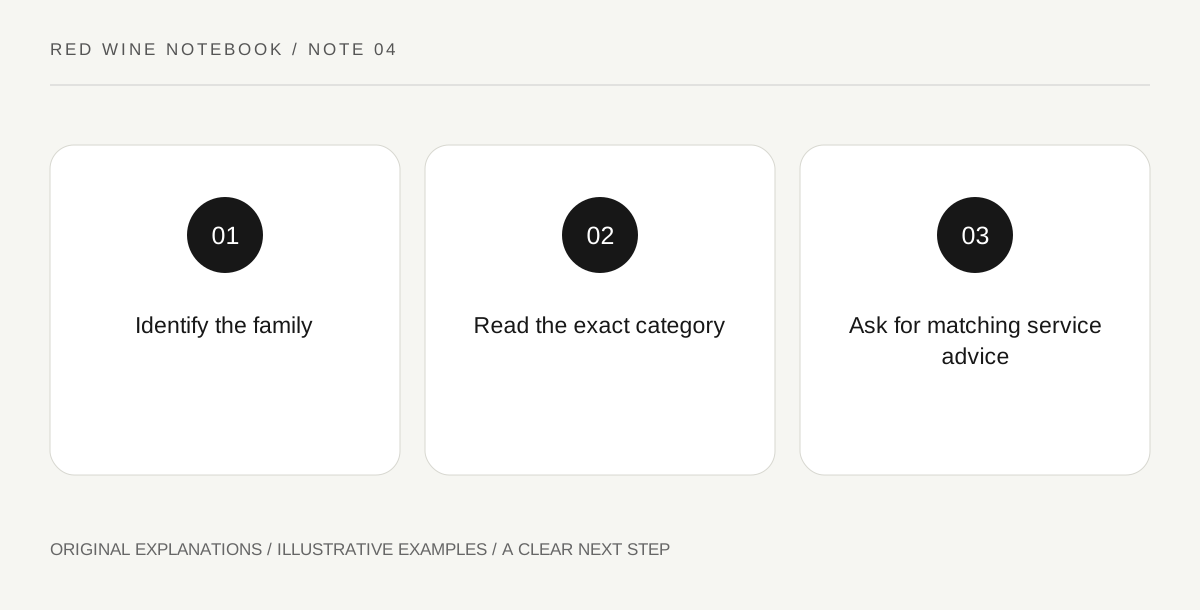
Original explanatory diagram. Read the full method and limitations below.
Identify the broad maturation emphasis
IVDP groups Port into ruby and tawny style families according to maturation approach. Its introduction associates ruby with retaining youthful red color and fruit, and tawny with wood-matured development. Keep this as orientation rather than a compulsory set of aromas in every glass. A broad family name does not replace the exact producer, category and bottle details, but it narrows the questions you need to ask next.
Keep color as observation rather than a shortcut
A red-derived wine can develop tawny tones, and Port is not restricted to one visible color category. Do not infer the grape ingredients, sweetness or value solely from appearance. If you have only a menu line, ask for the actual style and category. A useful note records the label information and then, separately, the color you observe. This prevents a sensory impression from silently supplying a production fact that the venue never stated.
Read the actual service and opening advice
Different Port categories can have different guidance after opening. Seek the producer's advice for the exact bottle instead of carrying a general fortified-wine storage rule across every style. A resealable closure does not guarantee indefinite preservation. Keep serving optional and avoid buying a large format solely because the unit price appears lower. The relevant package is one that fits the intended use and storage, rather than one that encourages an unwanted amount of consumption.
Choose a preference dimension
An adult interested in exploring the distinction can begin by reading two producer descriptions rather than opening both bottles. Ask whether youthful fruit emphasis or more developed wood-maturation language appeals to the intended occasion. If you later make an observation, keep it specific and modest. More age or a higher price does not automatically make one bottle more enjoyable for you. The family distinction supports comprehension; it does not demand a ladder of increasingly expensive purchases.
Illustrative worked example
Illustrative scenario: a shopper focuses on a large age number on one Port label but cannot name its style. They first identify it as an age-indicated tawny, then compare its description with a ruby-family option. Their choice can now concern the intended flavor direction and occasion. They ask about the actual bottle's opening guidance rather than assuming every fortified wine remains unchanged for months.
Questions that come up
Is tawny simply ruby left open at home?
No. The family distinction concerns controlled production and maturation. Leaving an opened bottle exposed is not a way to reproduce a commercial style.
Does older automatically mean better for everyone?
An age or category statement supplies information, not a universal personal preference. Choose according to the intended style, context and budget without pressure to consume.
References and scope
These sources support the factual background. Examples and exercises are original illustrative teaching material. References do not imply endorsement.
- IVDP: Port Introduction — Ruby and tawny families emphasize different maturation styles; not a universal bottle-age requirement.
- IVDP: Special Port Categories — Vintage, LBV, colheita and age-indicated tawny labels identify different categories.